Tuesday, June 25, 2024

Defense or Offense!

When thinking of aircraft manufacturers, many folks who are interested in the aviation history of Buffalo, New York generally think of Bell or Curtiss-Wright. Relatively few will think of the Consolidated Aircraft Corporation which operated out of Buffalo for eleven years, from September of 1924 to September of 1935.

Today we present an old print ad for Consolidated from the June 1935 ish of Aero Digest, featuring the A-11 / P-30 / PB-2 family of attack and pursuit planes. The basic design was somewhat successful, and Consolidated received production contracts from the US Army totaling 54 aircraft; four P-30/PB-2s and fifty P-30A/PB-2As. But the type was already obsolete by the time it entered service and further development was not pursued.

Just a few months after this ad ran, Consolidated would close up shop in Buffalo and relocate to San Diego, California where they would begin work on numerous designs, including two of the most well-known and successful aircraft of the Second World War: the PBY Catalina and B-24 Liberator.


Project 914 Archives


Fade to Black...


Monday, June 24, 2024

Sentry Over the Falls

A bit of 'airplanes over the Falls' randomosity today...

A NATO E-3 Sentry soars over WNY's most well-known water feature.

For those of our readership of right around zero to three who are unfamiliar with the type, here's the scoop: The E-3 Sentry is an AWACS bird developed from the Boeing 707 airliner. Now, I know what you're gonna ask: 'What's this AWACS business?' Well, lemme tell ya.

AWACS = Airborne Warning and Control System. Basically, these jets are equipped with BIG radars and other sensors, fly around in circles, often in areas of conflict, and keep an eye on... everything. Whether it's in the air or under the air, they see it. They are the prime command and control asset either on or above most any battlefield (oh, sorry, the current terminology is 'battlespace'). If they're tasked with protecting a given area and unknown aircraft approach, the folks sittin' inside these flying radar stations are gonna notice, and they're gonna tell their friends, and their friends are gonna go take a looksee and say, "Heeeyyyy... whutcha dooooin?" And then, well, the story can splinter into any number of random scenarios from there.

The TLDR is this: The E-3 can do everything from simple surveillance, to coordinating a multi-layer defense of the battlefie... errr... battlespace, to helping you find your car keys. Well, they probably wouldn't be tasked with the latter mission, but they're undoubtedly capable.

Anyhoo, as to the photo; we have no further info. We dunno who took the photo, why they took it, or when. However, the internet tells us that the pic may have come from the NATO archives. And of course, you can always believe everything you see, hear, and read on the internet, right? Well, that's probably a reasonable claim, and may very well be true. But until we discover more concrete info concerning this photo, we'll just leave it at that.


Photo source/credit unknown


Fade to Black...


Saturday, November 5, 2022

One Of the Local Bartenders

While your blogmeister does not work at the Buffalo airport itself, his place of employment is quite literally *at* the airport, just the other side of the fence. Such proximity during the daily grind affords him many an opportunity to see, hear, feel, and sometimes even smell things with wings, often by simply looking out the door that's just a few feet from where he spends 8 to 10 hours each weekday.

The usual sights consist of rather mundane flying machines, made a bit less boring by the bright colors with which they're adorned, accented by the names 'Southwest', or 'American', etc. Every now and again, however, something a tad more interesting shows up at 'ole KBUF, including one that appeared many weeks back... a certain bird that your blogmeister identifies as a VC-25A, but which the masses know more colloquially as 'Air Force One'.

Anyhoo, the subject  of today's installment of BuffaloWingz ain't 'Air Force One' (look for that soonly-like, in a future installment), but could conceivably be referred to as such if the right circumstances were to come about at some point. (Doubtful, but hey, we can dream, can't we?) And in any case, while the photos below ain't the goodest your blogmeister has produced, they show a bird that he finds infinitely more interesting and freakin' groovy than the flying White House.

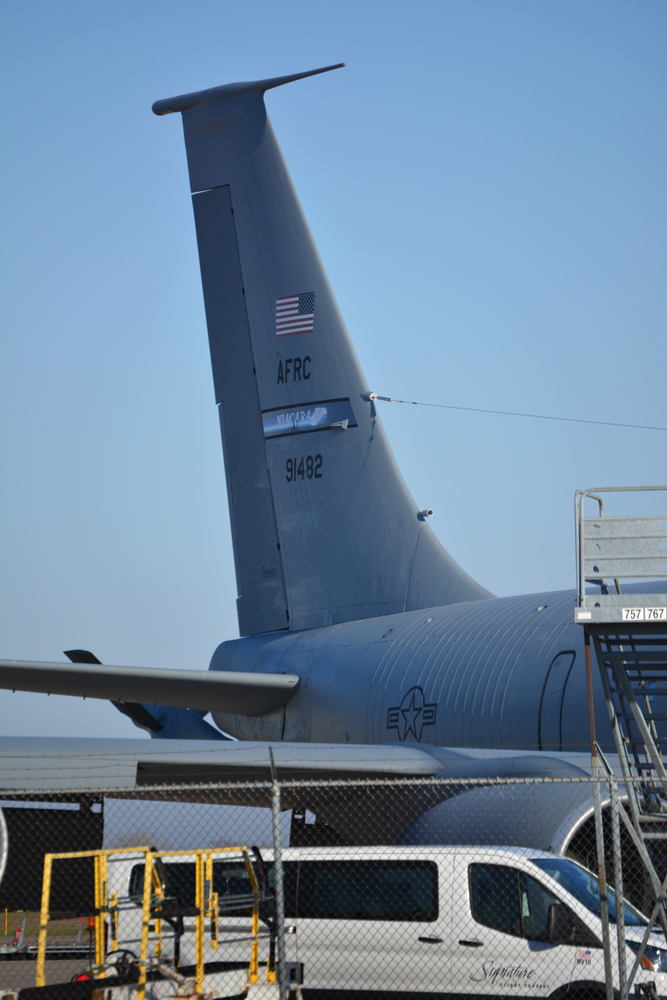
As he was leaving work the other day, your blogmeister was informed by Jim, the building custodian, that there was a 'tanker' just down the road, at the post office. Now, most folks would probably hear that and say to themselves, "Wut-da-hell's so exciting 'bout a gas truck and why's it at the post office?" But, being the nut for things with wings that he is, and knowing that said custodian was once in the USAF, your blogmeister also knows what the word 'tanker' means when passing between 'ole Jim's lips, and so decided to take a slight detour on his way home from work to take a looksee at the ramp down at the USPS Buffalo Air Mail Facility. The following photos resulted from said detour. Again, they ain't the most-bestest ever taken by yours truly, but... what the hey.

Oh, and at this point, I must point out that Jim was not only in the USAF, but he once served with the very outfit that operates the tanker in the photos... albeit back when said outfit was in the moving business, and not aerial bartending to gas-guzzling jets. (Don't tell Jim I told you that, though... he's a humble sort and doesn't like the publicity.)

What's that you ask? Oh, geez, how'da-hell could I almost forget? The 'tanker' is a KC-135R flown by the 328th Air Refueling Squadron of the 914th Air Refueling Wing, USAFRC, out of Niagara Falls ARS, NY.

Enjoy, and don't forget to tip your boomer...


BuffaloWingz photos by S.Donacik


Fade to Black...


Tuesday, July 20, 2021

Impromptu Airshow

Your blogmeister trekked up to the Falls to see a band recently, and while we were waiting for the openers to take the stage, a large-ish 'airliner' wheeled right over the outdoor concert venue, and fairly low, too. This was no surprise, as said venue was the proverbial stone's throw from the Niagara Falls airport. And though your blogmeister was in bird-watching mode, it was a very different, infinitely more-interesting kinda bird that had caught his eye at that particular moment. Though he is as big a nut for things with wings as anyone, your blogmeister readily admits that cheesecake will win out every time. So, upon half-glancing up at the 'airliner', his attention was not significantly diverted from a particularly well-fitting pair of home-ripped daisy-dukes.

Anyhoo, some while later, this 'airliner', which kinda looked like a 737, came by again.

Then again.

Okay, someone's shootin' touch and gos. Not something that you usually see airliners doing.

Soooo, the camera came outta the bag, was turned skyward during the next pass, and its wielder was rewarded with a glimpse of the word 'NAVY'.

Oooooohhhhh. That ain't no 737. It's a P-8A Poseidon.

Click.

It ain't a great image, because though the forecast called for no precip, the overcast skies seemed to threaten otherwise, and Sol was getting closer to the horizon.

So, to use a technical term, the lighting sucked.

But your blogmeister is not one to be put off by crap illumination when there's something worth snapping away at. Matter of fact, so-called 'crap' illumination often makes for way groovier images than bright sunlight at your back. Also, this was the first P-8 your blogmeister had seen with his own eyes, so he just hadda... and here 'ya be. A not-so-kinda-semi-sorta-crapola snap of a P-8A from VP-30, the FRS RON for the type...

 
a BuffaloWingz photo by Steve Donacik


Fade to Black...


Friday, July 10, 2020

June Bug Over Niagara

Yeah, yeah... we know. Been a while. Sue us.

For our first post here at BuffaloWingz in more than a few, we offer this super-FREAKIN-groovy shot of a Super Bug family model from VFA-106 'Gladiators' that was snapped a couple'a 'Cutting Edge' calendars back, at the June 2018 edition of 'Thunder of Niagara'. VFA-106 was then and is currently the East Coast Super Bug RAG/FRS. If you don't know what that last means, google it. Your blogmeister is still grumpy over the F-14, VF-101, VF-41, VF-32, and all the other *real* FITRONs, as well as the fact that it's been ages since the last 'Cutting Edge' calendar, and he's in no mood to explain stuff at the moment. (Don't know what 'The Cutting Edge' is? Google it, ya damn kids...)

Anyhoo, enjoy the snap, dammit...

James Neiss, Niagara Gazette


Fade to Black...


Monday, September 2, 2019

WNY Vets

Every once in a while we here at BuffaloWingz like to plug other web projects that we're working on. This time it's a website that your blogmeister created to honor all vets from the Buffalo and Western New York area, not just those who punched holes in the sky. We dig airplane drivers, but also tip our hats to the ground-pounders and the squids.

Anyhoo, the site is still rather small right now, but she'll grow. And we'll probably be sharing some of the aviation related pages here in the future. Matter of fact, we'll share one of 'em now.

Aviation Radioman 3rd Class Joseph Bauer of Lancaster, NY rode the back seat of a Curtiss SB2C Helldiver in WWII, though, sadly, only briefly. Find out more HERE...

WikiTree via WNY Vets


If you're inclined, please click HERE to give the whole site a looksee. Mind you, it's still a work in progress and certain sections and features have yet to be added. So be easy on us! Enjoy.


Fade to Black...

Saturday, July 20, 2019

Breathing Where There Is No Air

Today is July 20th, 2019.

Fifty years ago this day, man first landed on the Moon.

Hours later, at 02:56 UTC, July 21st, 1969, Neil Armstrong became the first human to set foot on the lunar surface.


The Project Apollo Archive


Hundreds of thousands of people in the USA and from around the world helped make it happen.

My Dad was one of them.


In June of 1966, Norbert G. Donacik graduated from Erie County Technical Institute and went to work for an aerospace company called Carleton Controls Corporation in East Aurora, NY. At the time, Carleton was working on a contract for Hamilton Standard in Windsor Locks, CT, developing life support equipment for Project Apollo. Although it was not his first assignment at Carleton, he was switched to the Hamilton Standard job within a short time, doing A&T (Assembly and Test) work primarily on components for the OPS (Oxygen Purge System), as well as other components for the PLSS (Portable Life Support System) and the life support systems on the Apollo spacecraft, though I regret to say that I don't know any particulars beyond his work on the OPS.


This photo shows my Dad, Norb 'Bruno' Donacik, at Carleton maybe a year or three after the end of Project Apollo, judging by the 'Shuttle Is Our Future' pin on his work shirt.

Project 914 Archives (S.Donacik collection)


While the PLSS was the main means of keeping the Apollo astronauts alive during an EVA (Extravehicular Activity - any crew activity that takes place outside of a spacecraft in space or, in this case, on the Moon), the OPS was the emergency backup system for the PLSS, and supplied about half an hour of  breathing oxygen if used on its own, or roughly 90 minutes if used with the BSLSS (Buddy Secondary Life Support System). There were actually two earlier backup systems developed by Carleton, each referred to as the EOS (Emergency Oxygen System).


The first EOS...

From: Apollo PLSS - Environmental Control of the "Smallest Manned Space Vehicle"


...and the second EOS.

From: Apollo PLSS - Environmental Control of the "Smallest Manned Space Vehicle"


Both of these met the specifications under which they were developed, but, as is often the case, the specs changed. Each EOS shown here would have provided just five minutes of breathing oxygen, which was clearly not much. So, under the revised specs issued by NASA in mid-1967, the greater-capacity OPS was developed and adopted for use during all of the manned Apollo missions. Thankfully, the OPS was never actually utilized in its primary role as an emergency backup.


Here's an OPS, held inverted, while being inserted into its fiberglass shell.

Project 914 Archives (S.Donacik collection)


And here's a look at the PLSS and OPS together in the Lunar EVA configuration, both housed in cutaway shells without thermal covering. In addition to the OPS, I believe that my Dad also did work on the primary oxygen supply and oxygen regulator, both located in the lower half of the main PLSS housing, but I don't know the extent of his involvement with those particular components.

NASA


In this photo taken on the Moon by Neil Armstrong, 'Buzz' Aldrin is shown carrying two experiment packages, one of which was the Seismic Experiment. (More on that below.) The PLSS is housed in the large 'backpack', while the OPS is inside the smaller pack on top.

The Project Apollo Archive


A series of three photos taken by yours truly at the National Air and Space Museum showing the cutaway PLSS/OPS they have on display. This first shot shows the same side that's facing the camera in the previous photo of 'Buzz' Aldrin on the Moon.

 S.Donacik photo


The opposite side...

S.Donacik photo


This last shot shows the OPS regulator and O2 bottles in gold. These are the components that my Dad did A&T on... it was so cool to go to a place such as the NASM and see something that my Dad held in his hands... something of such historic import and significance.

S.Donacik photo


Upon departing the Moon, the crews of each mission left behind many objects, including their PLSS packs, though I am not sure exactly what happened with all of the OPS units. I know that in some of the later missions the crews brought them back, at least as far as lunar orbit, in case there was a problem while docking the LM (Lunar Module - the craft that landed on the Moon) with the CSM (combined CM - Command Module and SM - Service Module, 'home' for the entire crew during most of the mission) and an EVA was required in order to enter the CSM. Once a successful docking and transfer of crew took place in lunar orbit, the LM was set to crash into the lunar surface, and I'm guessing that some of the OPS units were left in the LMs... but simply do not know for sure, because I have read that there was at least one instance of an OPS being used during an EVA on the way back to Earth, and also that a few other OPS units were actually brought all the way back to Earth. I don't know how much of these latter two points is true... haven't been able to confirm any of it through an official source, so, again, I don't know what happened with all of the OPS units.


Here's a photo taken from Antares (LM-8) before Apollo 14 left the Moon. Visible are both discarded PLSS packs, one of which clearly shows that the OPS has been removed.

The Project Apollo Archive


Funny little story here... remember the seismic experiment from Apollo 11 that was mentioned earlier? (Read about it HERE.) When Armstrong and Aldrin tossed their PLSS packs out of the Eagle (LM-5), the boys back on the ground at Houston not only saw it through the TV camera, but each 'thud' also registered on the seismometer Aldrin had set up earlier. Upon notification of this, Neil Armstrong apparently said something to the effect of, "Geez, you can't get away with anything anymore, can you?"

Anyhoo, it's probable that at least some of the OPS units remain on the Moon. And I gotta say, even more cool... WAY more cool than the experience of seeing my Dad's handiwork at the NASM... is the idea that some of his handiwork is still up there, and will be for all time... even if it's in pieces and spread across the lunar surface.

I mean, how frakkin' awesome is that?!?


------------------------------------------------------------------------------------------


My interest in this subject far outweighs my knowledge, and what I've presented here is obviously a very simple, basic explanation of the Apollo OPS. If you're looking for more detailed information, here's a couple'a links...

Apollo PLSS - Environmental Control of the "Smallest Manned Space Vehicle"

Apollo Oxygen Purge System


This link is to a video... 'tis a neat look at one of the OPS coverings that was brought back to Earth:

Looking at Moon Dust: An Apollo Artifact Comes Out of Storage


One last link, to The Project Apollo Archive, where you will find TONS of photos taken throughout the entire Apollo program, including these three, which are among my very favorites of those taken by the Apollo 11 crew.

The Project Apollo Archive

The Project Apollo Archive

The Project Apollo Archive


And we'll finish off with this... just 'cuz...

S.Donacik photo


Fade to Black...


Sunday, July 14, 2019

A Barn Owl From Buffalo

Of all the types produced by Curtiss in Buffalo during the 1930s and 40s, the O-52 Owl is probably in the top five on many a wing-nut's 'obscure' list. Whenever I see a photo of an O-52, it's almost always accompanied by a chorus of enthusiasts singing the same refrain, 'Hmmm... that's a new one on me'.

The O-52 is interesting in that it was not only ordered by the Army Air Corps without having tested a prototype (which in and of itself was not so awfully unusual), but more so because no prototype was ever built to test. Your blogmeister has found precious little information about the development of this wonderful, tubby little O-bird (that's wing-nut parlance for 'observation aircraft'), and no specific details as to why the type flew straight off'a the proverbial drawing board and into production. We here at BuffaloWingz are sure that the straight-dope is out there, hidden, camouflaged, waiting to be found... just haven't spied it yet.

What we do know is that, like so  many military aircraft produced in the USA during the mid to late 1930s, the Curtiss O-52 Owl was dang-near obsolete right from the get-go. Production began in early 1941 and the type was tested under operational conditions for the first time during the well-known US Army GHQ Maneuvers later in the year. The airplane was found... wanting. Actually, to be fair, it wasn't only the O-52 that was found wanting. In light of the then-modern battlefield conditions observed during the war in Europe up to that time (see what we did there?), the whole idea of the so-called 'heavy observation aircraft' was called into doubt.

Now, your blogmeister could keep rollin' down the tracks on this train of thought and wind up wandering far outside the scope of this-here cyber-rag. But he ain't gonna... and this bit is getting too long anyway, so... lemme backtrack a bit in order to wrap it up.

The Curtiss O-52 Owl first flew in February of 1941. As has been mentioned, the type went straight into production... no traditional prototype was produced... the early production ships were used as service test models, similar to the first few early production examples of a much more well-known Curtiss product; the P-40.

Anyhoo, the photo we present here today for the enjoyment of our readership of less-than-half-a-dozen or so shows one of these early production O-52s at the Buffalo Airport on Genesee St. in Cheektowaga, NY.

The date, May 30th, 1941.

The guy with the pikshur-maker... the legendary Rudy Arnold.

Enjoy.


NASM (Rudy Arnold photo)


Oh, as we may have mentioned in the past, your blogmeister is also a webmaster. If you wanna see a few more photos of the O-52, take a looksee at THIS PAGE from a little 'ole website known as the 'Hawk's Nest'.


Fade to Black...


Friday, June 29, 2018

Flying Not So High

In this installment of 'BuffaloWingz' we present a super-freakin' groovy photo taken by former Canadian Forces CF-18 pilot and six-string-astronaut Chris Hadfield while flying with the Snowbirds over Niagara's Horseshoe Falls back in August of 2013. Enjoy...

Chris Hadfield photo


Fade to Black...


Thursday, May 31, 2018

Air Niagara

Today we present a fine snap showing one of just two 727s flown by Air Niagara, a small, two-route line which operated out of Niagara Falls International Airport from 1982 to 1984.


Trevor Ogle photo


Fade to Black...


Wednesday, May 30, 2018

An Old Campaigner from Buffalo

This time 'round we present a photo taken in 1943 at Blackland Army Airfield, Texas which shows six airmen who, unlike the majority of their comrades at the time, had been around the block... some more than once. All but one were veterans of the Great War, and all were decorated in one way or another, including the fella on the far left; Private Leroy G. Payne, a native of Buffalo, NY.

Oh, almost forgot to mention... the bird behind them is a Beechcraft AT-10 Wichita.


Project 914 Archives


The tag from the reverse of the photo with more info on Private Payne and the rest of these fellas...


Fade to Black...


Saturday, May 26, 2018

Schoellkopf and The Stump Jumper

With this installment of 'BuffaloWingz' we offer a two'fer...

The photo presented here shows 'The Stump Jumper', a Curtiss P-40F Warhawk of the 79th Fighter Group's 85th Fighter Squadron, which was known as the 'Flying Skulls'. The Hawk's master, shown on the left, was Major Jacob F. Schoellkopf, the 'Skulls' commanding officer. Both 'The Stump Jumper' and Major Schoellkopf served in the MTO during the Second World War, and both came from Buffalo, NY.

From: The P-40 Kittyhawk by Ernest R. McDowell (R.M. Hoffman)


Fade to Black...


Friday, May 25, 2018

The Hawk's Nest

Been a while... your blogmeister has been busy updating and improving other web projects; primarily one that he created more than a dozen years ago. That project, known as 'The Hawk's Nest', is an homage to the Curtiss P-40 Warhawk. Please give it a looksee, HERE.

Anyhoo, as he's plugging his P-40 website, your blogmeister figures that a purty pikshur of the type would be in order. So here's a lovely inflight shot showing two nearly brand-spankin'-new P-40s (the initial production model), taken by the legendary Rudy Arnold. Enjoy...


Project 914 Archives (S.Donacik collection)


Fade to Black...


Tuesday, August 2, 2016

Fill'er Up!

On August 2nd, 1958, fifty-eight years ago today, the U.S. Navy's Blue Angels, flying the Grumman F11F Tiger, were performing in Western New York skies as part of the festivities celebrating the sesquicentennial of the Town of Clarence, a suburb of Buffalo.

At a few minutes past 5PM that Saturday, just before he was to start his solo routine, Lt. John R. Dewenter, the lead solo, experienced an engine failure. When the fan stops turning, it's generally advisable to point the bird in a direction of sparse population and go for a ride in the bang seat. But instead of ejecting, Lt. Dewenter chose to stay with the jet and try to make Buffalo Airport because, as he put it, "there were just too dog-gone many houses down there."

Well, Lt. Dewenter did make the airport, touching down on runway 23 near the northeast edge of the field. Unfortunately that runway was too short for the Tiger. The jet ran off the end of the runway, barreled past the airport boundary and into the intersection of Genesee St. and Dick and Cayuga Roads, narrowly avoiding collision with road traffic, reportedly due in large part to a timely red light, and coming to rest near Joseph DeLuca's Mobilgas service station. Nobody was injured, including Dewenter... but the jet was apparently a write-off.

The following photos were kindly provided by Robert Lackemeyer. Thank you, sir!


Those among our readership of about half-a-dozen or so who are in the know may catch an apparent discrepancy here... if Lt. Dewenter was the lead solo, why was he flying jet #6, normally flown by Lt. John Damian, the opposing solo, instead of #5? Here's a quote from one of the sources linked below which explains:

"John Damian and I had inaugurated our "back-to-back" pass that year. John did the inverted portion of that maneuver but had been experiencing low oil pressure warning lights which forced him to break off the pass and return immediately to normal flight. For the sake of the maneuver he convinced me that morning that we should switch aircraft for the show. We did, and you know what followed. What incredible timing!"


And here's a shot showing our hero of the day... Lt. John R. Dewenter, with his F11F Tiger.

Source: The Golden Eagles website


Take a looksee HERE for more detailed accounts of this incident, including some that were taken from the August 4th, 1958 edition of The Buffalo News. Be sure to follow the three links at the bottom of the page to see everything.


Fade to Black...


Thursday, October 1, 2015

Flight of the Airacomet

Every now and again we like to acknowledge anniversaries around here. So, in this quickie installment of BuffaloWingz, we tip our hats to the Bell XP-59A Airacomet, which flew for the first time on October 1st, 1942... seventy-three years ago today.

USAF (af.mil)


Sometime back we had another short installment on the Airacomet... see that HERE.


Fade to Black...


Thursday, September 11, 2014

An Earlier September 11th...

Approximately 5PM, Friday, September 11th, 1942...

Curtiss test pilot Jack Bertrand Purnell is behind the stick of a brand new P-40 Warhawk on a routine acceptance flight high above Curtiss Plant #2 at the Buffalo Municipal Airport in Cheektowaga, NY. All seems to be going well on this test hop until, roughly quarter past the hour, smoke begins to seep into the cockpit... then flame.


Jack Purnell...

Original image: The Buffalo History Gazette


Purnell does what he can to try to extinguish the fire but is unsuccessful. The heat, growing in intensity, becomes unbearable and he decides that it's time to hit the silk. He rolls the ship over onto its back, pulls the emergency release for the canopy, unstraps himself from the seat, and falls clear of the burning pursuit ship. Purnell is able to deploy his Irvin parachute, in spite of the agony he is suffering from the burns he has received, and begins a slow descent to the ground, eventually coming down near the intersection of Walden and Union Roads.

From: Lockport Union-Sun and Journal, September 12th, 1942
via fultonhistory.com


Meanwhile, the flaming Warhawk that Purnell has just abandoned flies on erratically for a few minutes... observers on the ground report that the ship went through several loops and other wild maneuvers, shedding a piece of itself in the process (later discovered to be the drop tank) before finally plummeting toward Earth, and crashing into the nest from which it was hatched... Curtiss Plant #2.


Your blogmeister is not certain which variant of the P-40 Purnell was flying at the time, but it was probably either a P-40F or a P-40K. Shown here is an early production P-40F with Curtiss test pilot Herb Fisher behind the stick.

Project 914 Archives (S.Donacik collection)


The aircraft struck the building's roof at an angle, shearing the wings off, while the mass of the engine carried the fuselage on through and into the workspace below, in the area of the tool crib. The impact produced a shower of shrapnel and gasoline... the latter igniting immediately in "a blinding flash", as one of the workers described it. The engine buried itself three feet into the concrete, while the disintegrating fuselage slid roughly 60 feet across the floor, continuing to spray the area with flaming gasoline, which accounted for the majority of the casualties.


From: Buffalo Courier Express, September 12th, 1942
via fultonhistory.com


This photo was taken sometime during 1943 and in a different area of Plant #2 from that in which Purnell's ship came down, but we include it here simply to give ya'll a glimpse of how the inside of this place might have looked on the day... just moments before the chaos.

Project 914 Archives (S.Donacik collection)


A total of fourteen people died as result of the accident, two of whom, Francis Ryan and Samuel Shalala, were killed instantly upon the plane's impact.

via the Buffalo History Gazette


In all, there were thirty-four others injured including the pilot, Jack Purnell.

via the Buffalo History Gazette


In the moments immediately following the crash bedlam undoubtedly ruled... but, by all accounts we've come across, the folks at Curtiss, especially the medical personnel and those of the air raid precaution teams, bounced back quickly and performed admirably in the face of what must have been a terrifying scene of utter horror.

Speaking of the accounts we've come across, contained in the images below is the full coverage given to this incident the following day by both the Buffalo Courier Express and North Tonawanda Evening News.

We shall let them tell the rest of the story...


All full newspaper pages: fultonhistory.com


A Curtiss Company photo of Jack 'Bert' Purnell.

Alvin C. Smith collection via Brent Smith


Please check out this article on The Buffalo History Gazette's website. When your blogmeister first began digging online many years ago for info about this accident, that article was pretty much all he could find. Although it is mostly a transcription of excerpts from the Courier Express coverage, it does contain some unique material not found elsewhere... including a link to scans of a booklet that was distributed during a religious mass that was conducted in memory and honor of the victims. In addition, some of the comments made in response to the article are quite informative in their own right.


Fade to Black...


Wednesday, September 10, 2014

It Ain't Air Force One...

...but it's pretty dang groovy, just the same.

Your blogmeister was out at KBUF yesterday morning doing that shutterbug thing... but he was experimenting a bit, and caught nothing but a whole lotta 'fail'. Such is life...

However, an email from a friend arrived later in the day and, well, saved the day... witness this nifty shot of a groovy little Gulfstream operated by the FAA, touching down on Runway 23. Check out the registration... thanks Wayne!

Wayne Dippold photo


Fade to Black...